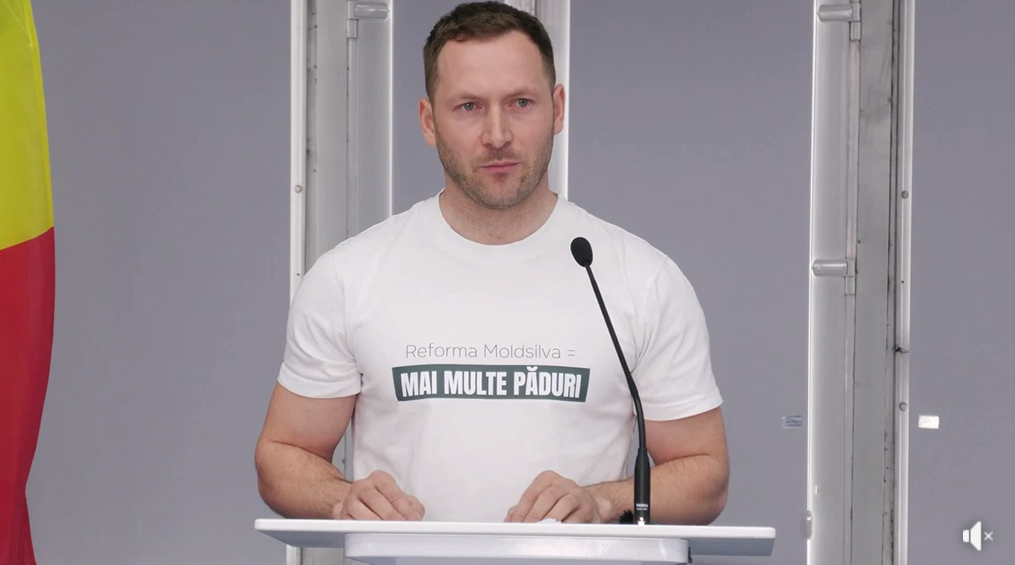
Today, the Minister of Environment, Gheorghe Hajder, announced the launch of the reform of the "Moldsilva" Agency during a press conference.
If one listens closely to the speech, it becomes clear that the ministry already possesses a sufficiently concrete vision for the upcoming changes: with a clear logic, a planned organizational structure, calculated performance indicators, and even an estimate of future cost savings to be reinvested into the sector. This is undoubtedly a positive sign!
The fact that we have more than just a general political slogan about the need for reform—but rather a substantial plan—is an important signal. It means this is not merely a declaration of intent, but an attempt to move toward a more systemic reimagining of how the forestry sector should function in the Republic of Moldova.
This is particularly vital given the scale and significance of Moldsilva. We are talking about one of the state's largest structures in terms of territorial reach, carrying a massive burden: forest fund management, afforestation, forest care, protection, timber harvesting, and, to a significant extent, providing the population with firewood. Undoubtedly, the theme of reform is long overdue.
Among the voiced approaches, the idea that timber sales should eventually be conducted from depots rather than directly from the forest deserves special attention. This appears to be a truly important and sound direction. In centralized depots, high-quality drying of timber can be organized, which directly impacts both resource efficiency and final costs for consumers. Well-dried wood provides significantly higher calorific value, which can reduce consumption several times over! For a country where many households still depend heavily on firewood, this is not a secondary issue, but a major social one.
However, alongside the organizational and economic changes, I believe another, more fundamental question must be at the center of the discussion.
In my view, if we truly want to preserve forests and consistently increase their area, staff in the forestry sector must be adequately funded from the state budget—just as is the case for teachers, medical professionals, police, and other systemic public services.
Foresters perform a crucial public function. It would be logical for their salary base and the system's stability to rely on clear state policy and budgetary responsibility, rather than on the constant pressure to cut and sell timber just to pay the staff.
Otherwise, the system itself is placed in an inherently contradictory position: on one hand, it is expected to conserve forests, manage them sustainably, and expand forest cover, while on the other, it is forced to constantly worry about how to fund current operations and payroll through timber sales.
Such an approach is difficult to call healthy in the long term. If the forest is viewed not only as a resource but as a strategic ecological asset—protecting soil, water, climate, and the public interest—then the system's financing should gradually be built according to this logic.
In this sense, the reform could be more than just an administrative process; it could be an opportunity to genuinely improve sector management, increase transparency, efficiency, and the quality of services provided, while simultaneously establishing a more sustainable financing model for the industry.
That is why it is especially important for the next stage to be organized with the highest possible quality.
If the ministry indeed has a concrete plan, it is all the more important for the public discussion process to be professional, calm, and substantive. The opinions and proposals of all stakeholders must be heard and included: sector workers at all levels, the professional community, trade unions, environmental NGOs, local communities, and the citizens who are deeply dependent on how the harvesting, storage, and sale of wood are structured.
The quality of this discussion will largely determine whether the reform becomes a factor in strengthening the sector or a source of new tensions.
The forestry sector is too sensitive and too important to be reformed solely through administrative measures. What is needed here is a combination of political will, professional expertise, and public trust.
I sincerely hope that this process will serve as an example of such an approach: where the state not only proposes changes but knows how to explain, discuss, refine, and strengthen them through substantive feedback.
If successful, the Moldsilva reform could become not just another restructuring, but a truly significant step toward more modern, rational, and sustainable management of Moldova's forests.
![More than 100 new trees were planted at the National Botanical Garden of Moldova [VIDEO]](https://arboretum.live/pub/media/mageplaza/blog/post/resize/400x/v/i/video-sreenshot_2.png)