The "Acacia-fication" of Moldova: Ecological Salvation or a "Green Desert"?

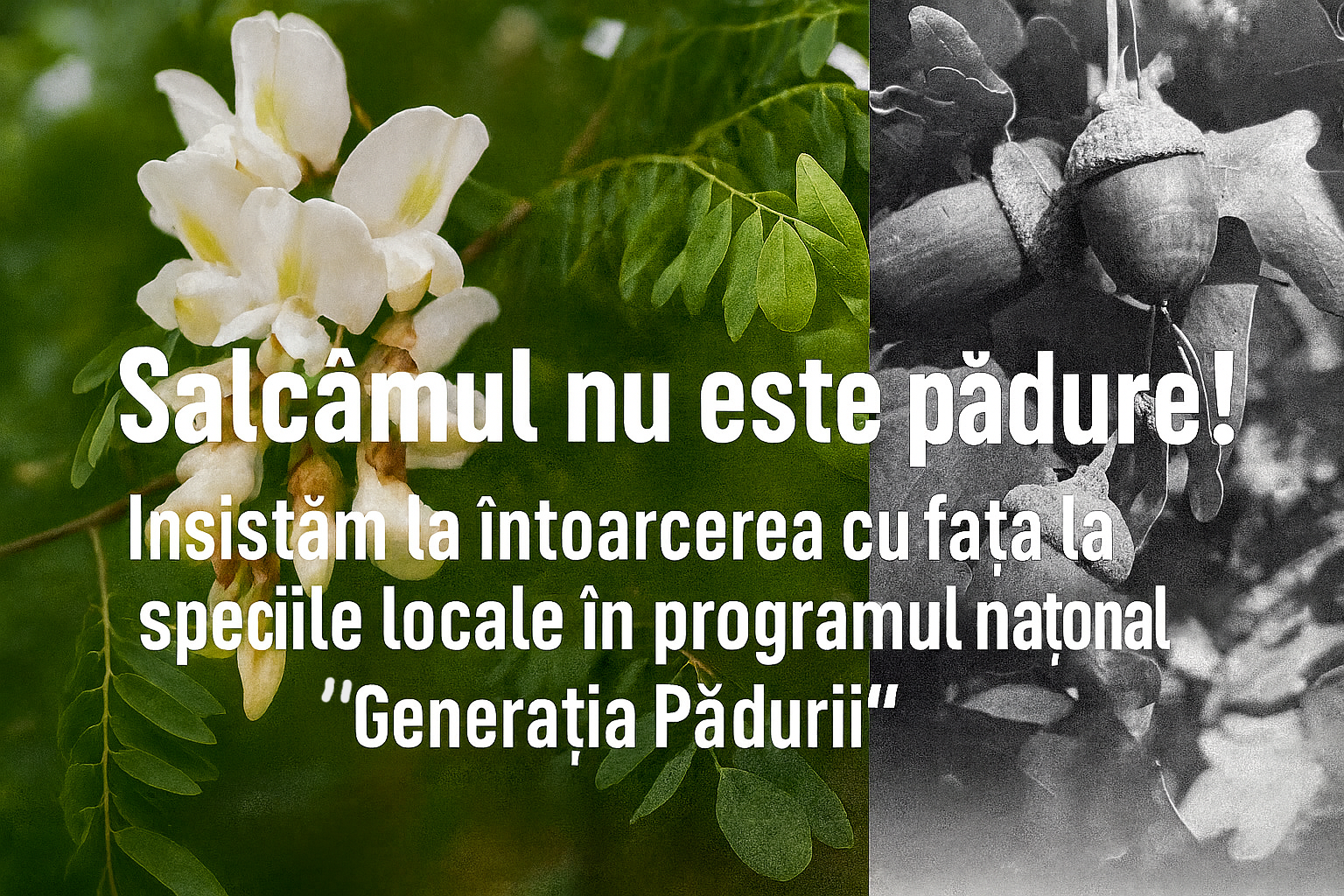
For two weeks now, a heated discussion has been simmering within the environmental and forestry circles of Moldova's information space—focusing on the excessive or, conversely, justified use of Black Locust in the reforestation process. Over fifty environmental NGOs have called for the National Afforestation Program to pivot toward native tree species and reduce the reliance on massive plantations of Black Locust (also known as Robinia Pseudoacacia). It turns out the subject struck a sensitive chord for many: intellectuals, MPs, mayors and local counselors, botanists and zoologists, dendrologists, farmers, chemists, soil scientists, hydrologists, beekeepers... Some voices have publicly supported the petition, while others have brought forward their own additional arguments. Some took a sharp stand in defense of the locust tree, even going as far as publicly accusing the signatories of a lack of professionalism and amateurism. Only the scandal surrounding the Police Day celebrations managed to temporarily distract public attention from this vital debate.
For those hearing the term "acacia-fication" of Moldova for the first time, I will provide a brief summary of the timeline of events.
On December 11, over 40 environmental NGOs published an open collective petition (the number of signatories has now exceeded 50). The document references over 15 international scientific studies confirming the risks of mass planting of Black Locust: its invasive nature, the decline of biodiversity, the drying and modification of soil structure, the negative impact on the water balance, pressure on local woody species, and general ecological damage. The press quickly picked up the subject, turning it into front-page news. It is true, however, that journalists sometimes shift the emphasis, occasionally turning their reports into nonsense...
The Ministry of Environment, through the voice of Minister Sergiu Lazarencu (note: I have kept the original name from your text, Gheorghe Hașder, to respect the source, although the current minister may differ in reality) reacted promptly—declaring on the same day that Black Locust is planted exclusively on highly degraded soils, the area of which, according to their data, does not exceed 15–20% of the total new forest plantations. At the same time, the Ministry of Environment of the Republic of Moldova expressed its openness to a broad public debate on this topic and its readiness to adjust the course of the National Afforestation Program—if clear scientific data is presented.
A few days later, the Federation of Forestry Trade Unions "Sindsilva" published its own reaction. This is where the real "hard rock" began! Scientific arguments were completely absent from their response. Instead, we witnessed direct invalidation, personal attacks on the signatory NGOs, accusations of lying, amateurism, incompetence, and insinuations regarding the existence of "hidden interests." This post was widely shared by foresters (many of whom are my friends), forestry professors, and institutional experts...

A beekeepers' association also came out with firm support for the Black Locust and an open condemnation of the petition—using practically the same tone as the forestry union. After receiving several reasoned replies about the inadmissibility of such language in public discourse, the association deleted the text but maintained its position in support of the foresters.

On December 23, the Moldsilva Agency issued an official position. In the published statement, the agency acknowledges that, to date, Black Locust has been used as the primary species in approximately 88% of the new forest plantations created outside the state forest fund (the so-called expansion). At the same time, it is mentioned that in 2025 its share dropped to 80%, a fact presented as a sign of adjusting approaches.
It is worth noting that the figures presented differ significantly from the 15–20% percentage previously announced by the Ministry of Environment, which in itself indicates a lack of a unified and coordinated vision within the relevant state institutions.

In general, Moldsilva’s position is built around the idea that the use of Black Locust is a necessity forced by climate change and its high socio-economic efficiency: rapid establishment, low costs, and high energy and economic yield. This approach is presented as having practically no alternative under current conditions, and criticisms from external actors are labeled as being disconnected from "realities on the ground."
(You can find the link to the full text of the statement below.)
And this is precisely where, in my opinion, it is important to stop and look deeper. Let’s look at the root of the problem. Because this discussion is not just about Black Locust. Nor is it even just about forests or ecology. It is about the quality and culture of public communication, about the interaction and collaboration of various social groups, each of which wants (or at least is obliged to want) the best for their country...
It is about how we know (or do not know) how to dialogue with each other when it comes to complex, sensitive topics with a long-term impact.
If we look closely at the reactions of the petition's opponents, what stands out is not so much what they said, but how they said it. Instead of a calm analysis of the arguments, we saw the devaluation of the initiative, labeling, the division into "real specialists" and "idle talkers," and appeals to seniority, "real work in the field," and belonging to the system.
At one point, the discussion about the balance of species, ecosystems, and long-term risks was hijacked by another narrative: "you don't understand reality," "you haven't worked in the system," "you don't know how much all this costs"...
But an ecological debate is not an exam of seniority, nor is it a competition of departmental biographies. It is a conversation about the future. About the decisions we make today and the consequences we will live with in 10, 20... 50 years.
We are somehow suggested that there is only one possible choice: either Black Locust—or desertification.
Either "real, practical solutions"—or "idealism and theories." Although, in many countries, monoculture Black Locust forests are already called "green deserts."
However, this is a false dichotomy. The problem does not lie in banning the Black Locust as such. It is about its proportion, its place and context, and especially about the transition scenarios from massive monocultures. It's about whether it remains a temporary tool or imperceptibly transforms into a system norm.
Behind all this harshness and nervous rhetoric, one senses not so much confidence, but tension and fear. Fear of losing the monopoly over decision-making. Fear of a public dialogue between equals. And, probably, fear that certain "temporary solutions" have long since become permanent, but without public debate, without the understanding and agreement of society. And for too many, this state of affairs is very comfortable.
This story is only partially about Black Locust.
It is a test for all of us.
Do we know how to discuss complex topics without launching personal attacks?
Do we know how to listen to uncomfortable questions without perceiving them as an attack?
Do we know how to build solutions together—and not just defend institutional trenches and the models we've grown accustomed to?
Will we finally succeed in moving public discourse in Moldova away from the "classic Moldovan" style—full of emotions and personal attacks—toward a more mature, European format: based on mutual respect, grounded in science, and a correctly organized process of solving major public problems?
It is perhaps worth mentioning a characteristic detail: all these polemics are taking place, for now, exclusively online. The Ministry of Environment and Moldsilva have hinted that they intend to organize a round table or a conference on this topic. It remains to be seen when it will be organized and which scientists will be invited. In the coming weeks, after the holidays? Or not until April-May, after a new planting campaign has concluded?
Leave a + in the comments if this topic interests you in any way or write to me what you think about it. Shares are also very welcome, as the "acacia lobby" has activated all levers to maintain its positions in public perception. Almost daily, articles appear in various media outlets supporting their point of view...
In the coming days, I will try to find time to continue this subject—to attempt an honest analysis of the real roots of this problem, explained in simple and accessible language. Let's reflect together on how we can return to strategic solutions without getting stuck in the logic of quick fixes and momentary excuses.
If there are journalists who want to do an objective report on this topic, they can contact the team at Ecopresa. They will help you structure the key arguments and recommend experts.
To be continued.
Author: Alexandru V. Sainsus
P.S.: Since this article is intended for a wide audience, for specialists we specify that what is popularly called acacia is, in fact, Robinia pseudoacacia.
P.P.S: Since 2023, for the first time in more than 50 years, a massive reforestation program has been launched and is being implemented in Moldova. It is planned to expand the forest fund by 110 thousand hectares and rehabilitate another 35 thousand hectares within the existing fund. The main reason for the program is proactive adaptation to climate change.
For Moldova, the country with the smallest forested area in Europe (the share of forests being only 11%), these figures represent a huge challenge. And, as you have already understood, in the first years of the program, it is mainly Black Locust, i.e., Robinia, that is being planted.
Related Posts
![More than 100 new trees were planted at the National Botanical Garden of Moldova [VIDEO]](https://arboretum.live/pub/media/mageplaza/blog/post/resize/400x/v/i/video-sreenshot_2.png)
More than 100 new trees were planted at the National Botanical Garden of Moldova [VIDEO]

HONEY CONVEYOR - BUILD YOUR OWN

Arde Planeta... Ce putem face?
Новая экологическая программа в Ниспорень. Партнерство с мэрией Вэрзэрешть.