
Reforestation Conference in Moldova: Outcomes, Consensus, and the Role of Black Locust

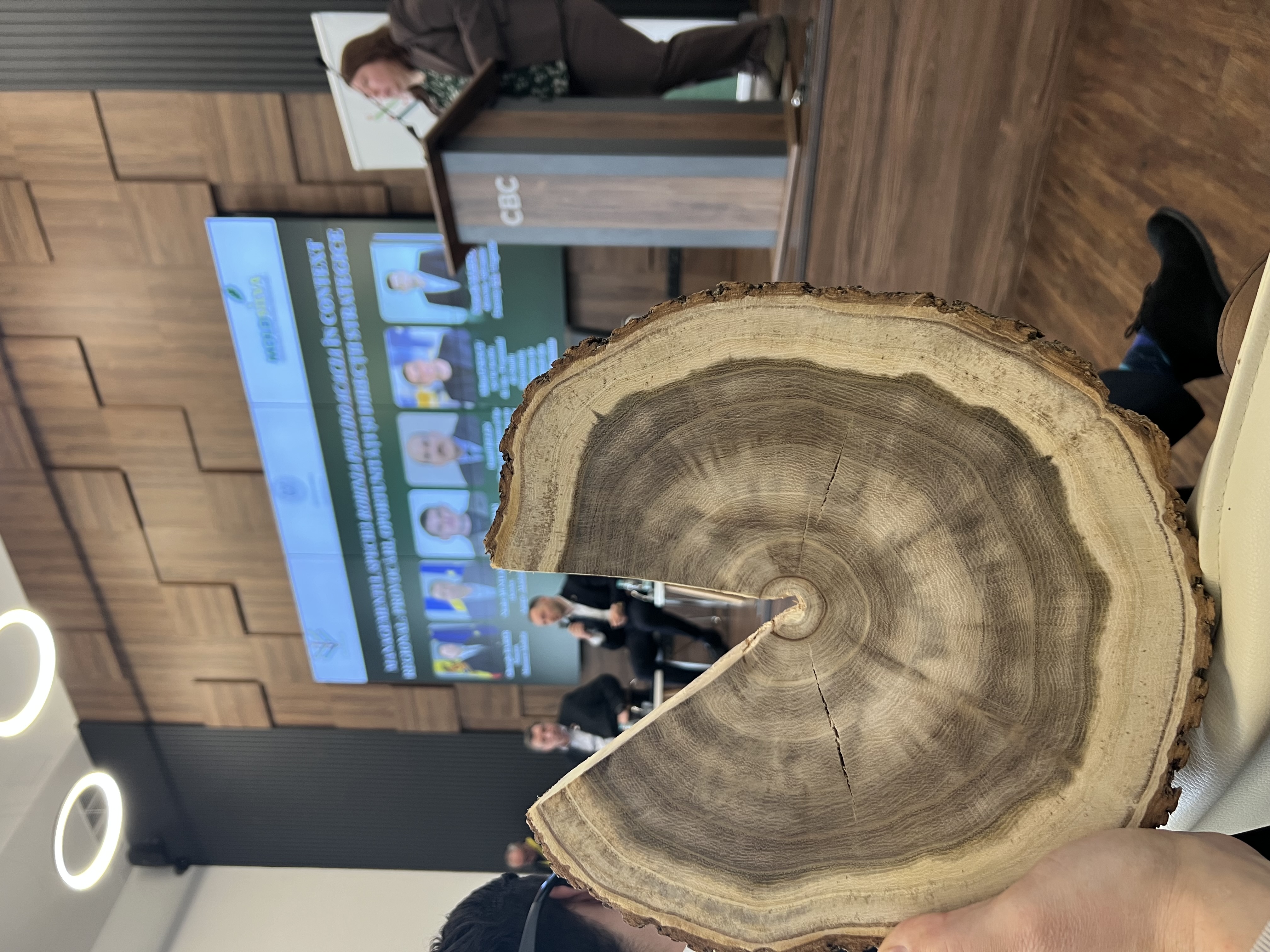
It was not just an exchange of ideas, but a real opportunity for communication between people who, despite coming from different backgrounds—civil society, academia, the forestry sector—are essentially working in the same field and for the country's best interests.
› Let's start with the real context of the conference
An important aspect, publicly acknowledged even by the organizers, is that this conference also came as a response to the petition submitted by 55 NGOs in December 2025. A brief summary of those events can be found here.
That initiative generated a lot of emotions and exaggerated reactions. Probably, it also caused a certain degree of frustration among some forestry colleagues who felt targeted.
Therefore, as a signatory of the petition and on behalf of the supporting colleagues, it is essential to emphasize once again very clearly:
→ The petition was not against the black locust (acacia) per se
→ And it was not against the foresters!
It was a call for rebalancing afforestation policies, particularly to increase the share of native tree species.
Because in the practice of recent years, black locust has been used, in many cases, disproportionately compared to the potential of local species. And the fact that the dialogue has continued and evolved into today's format is a very, very good thing!
› Where we met: an important consensus
An extremely valuable outcome of this conference is that we managed to mutually agree on some fundamental conclusions:
✔️ Black locust has a clear and justified role:
- on degraded lands
- on eroded soils
- in very low site quality conditions
- where rapid stabilization of soil structure is needed (ravines, steep slopes, landslides...)
❗ But where conditions allow for ecologically valuable native species (e.g., Oak, Sycamore, Sessile Oak, Hornbeam, Ash, Poplar...), they must be Priority No. 1
→ Under no circumstances should black locust be planted where a native forest can grow!
This simple but essential distinction helped de-escalate the discussion and created the foundation for a constructive dialogue.
› The missing conceptual distinction: energy plantation vs. forest
One of the ideas that needs to be stated more clearly, and on which I will insist, is this:
→ Not all forest plantations can be called a forest.
Black locust can serve multiple roles:
- energy
- economic
- melliferous (honey-producing)
- protective
- pioneer...
But a forest, as an ecosystem, implies:
- biodiversity
- long-term stability
- complex hydrological functions
The confusion between these two concepts generates many of the current tensions. And it probably needs to be discussed in more detail and reflected in legislation.
› Water: the critical variable we ignore too easily
Beyond the economic and technical arguments, I believe we need to look more closely at things through the lens of water. The disappearance of surface waters and the degradation of groundwater are the greatest ecosystem challenges right now and for the coming decades. The importance of water protection is a red thread running through the new Forestry Code of the Republic of Moldova (which entered into force in 2025), and it is also present in the rationale of the National Forest Extension and Rehabilitation Program (officially launched in 2023).
A simple exercise shows that:
- the annual growth of black locust (between 6–12 m³/ha) implies significant water consumption
- in many cases, this consumption can exceed all the water provided by precipitation
From this perspective, in certain contexts, black locust can become a crop that generates a hydrological deficit in the local ecosystem.
This does not cancel out its economic advantages—but it obliges us to analyze much more carefully where it makes sense to plant black locust and where it does not.
A detail worth mentioning is the audience's reaction to this analytical illustration. When I proposed this simple exercise to evaluate the species' water balance, there were no comments or additions from the forestry colleagues present.
By no means as a criticism, but rather as an observation:
→ we can deduce as an assumption that such calculations—which directly link forestry production to the hydrological balance—are not yet systemically integrated into current practice.
And perhaps this is one of the key points: contemporary forestry, in many contexts, has evolved significantly towards technical optimization and timber production, but there is clearly a need for a deeper reconnection with the ecological context in the broad sense of the word, especially with the interdependencies related to water, soil, climate, and fauna...
→ That is precisely why such discussions are absolutely necessary. Not to contrast positions, but to broaden the analytical framework and integrate complementary scientific perspectives—hydrological, ecological, etc.
This is, in fact, further proof of the need for an ongoing interdisciplinary dialogue.
› Technology as a solution: the opportunity of containerized seedlings
Another important point worth developing relates to the technological constraints acknowledged even at the institutional level. If we want more native species, we must have the capacity to produce and plant them efficiently!
→ Here, containerized forestry (seedlings with closed root systems) represents a real opportunity!
We are already seeing very good results in:
- improving root system quality
- reducing transplant shock
- adapting to stress conditions (drought, difficult soils)
- diversifying the species used
- extending the planting time window
It is one of the tools that can make adaptation to climate change possible—not just desired!
However, adapting containerized culture to local species requires a deep and multifaceted scientific approach. We have published an open appeal on this topic here.
› The value of applied science: the lesson from Hungary
An aspect that particularly impressed me was the presentation by our colleague from Hungary, Nemeth Marton.
Over time, they have carried out rigorous selection of black locust, identifying forms with clear added value:
- adapted to extremely degraded soils
- with extremely fast growth without losing wood density
- with straight growth, suitable for quality timber
- with a longer flowering period (important for beekeeping)
→ This is a clear demonstration that science can refine and improve even controversial species.
Therefore, I believe the correct position is a pragmatic one: if we choose to plant black locust in Moldova, especially aiming for economic benefits, then we must use selected, high-performing forms and maximize the use of research results.
› If we plant black locust, let's do it efficiently! In the same logic:
→ the use of black locust must be:
- intentional
- scientifically justified
- based on quality genetic material
› The most important lesson: communication
Perhaps the most valuable conclusion is neither technical nor economic. It is about sector governance:
→ we need a permanent platform for constructive dialogue between:
- civil society
- academia
- donors
- forestry sector representatives
- policymakers (Ministry of Environment and interconnected ministries—Agriculture, Economy...)
- intellectuals and opinion leaders
A dialogue: regular, collegial, based on data and science, but also on the broad public interest. The experience of colleagues from other countries clearly shows that the lack of this dialogue has led to:
- loss of public trust
- discrediting the sector
- destructive polarization
We in Moldova are still at a point where we can correct this trajectory.
› In lieu of a conclusion
The direction is, in fact, simple:
→ put science at the forefront
→ clearly differentiate the roles of species and types of plantations
→ jointly build policies based on realities, not extremes
And perhaps most importantly:
→ continue this conversation—not occasionally, but constantly, systemically, and in an organized manner!
Author: Alexandru V. Sainsus
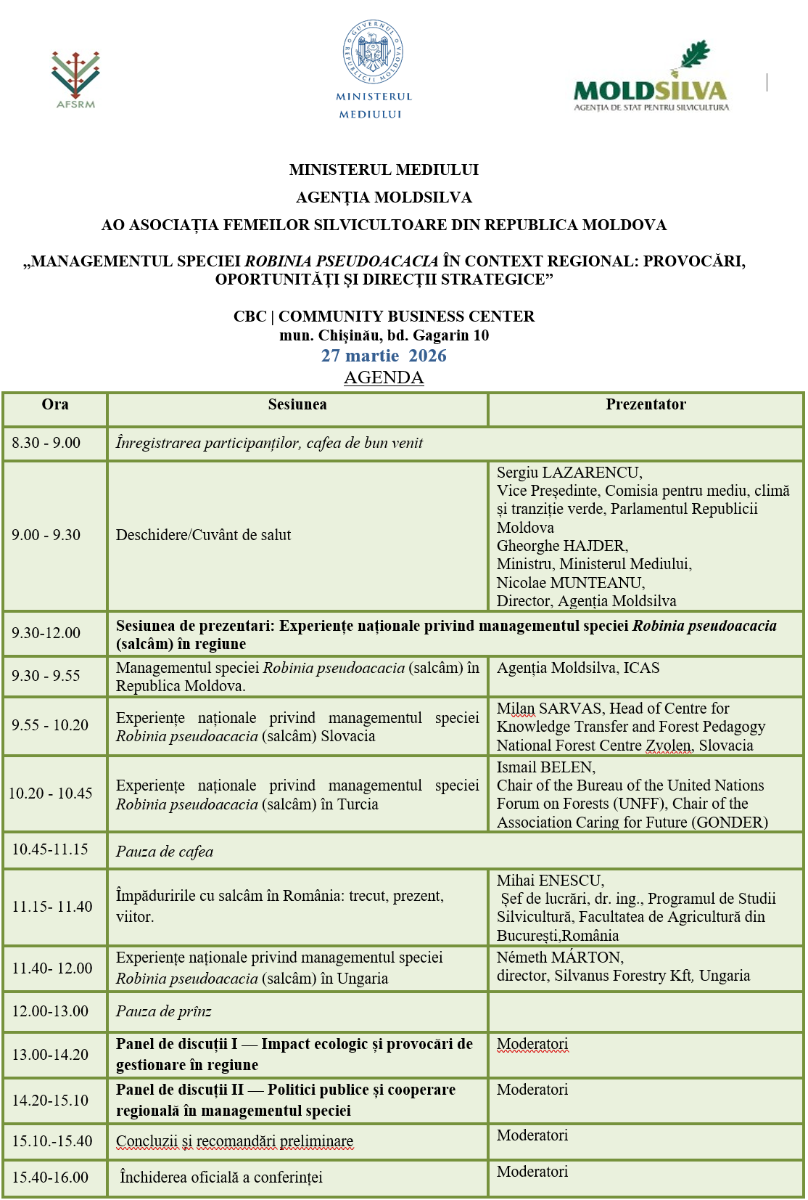
Here is the conference agenda. If you want to access the materials, please contact the organizers: Victoria Covali, Association of Women in Forestry.