Open Appeal: Accelerating the Transition to Containerized Seedlings in Moldova

Dear friends, supporters, and partners,
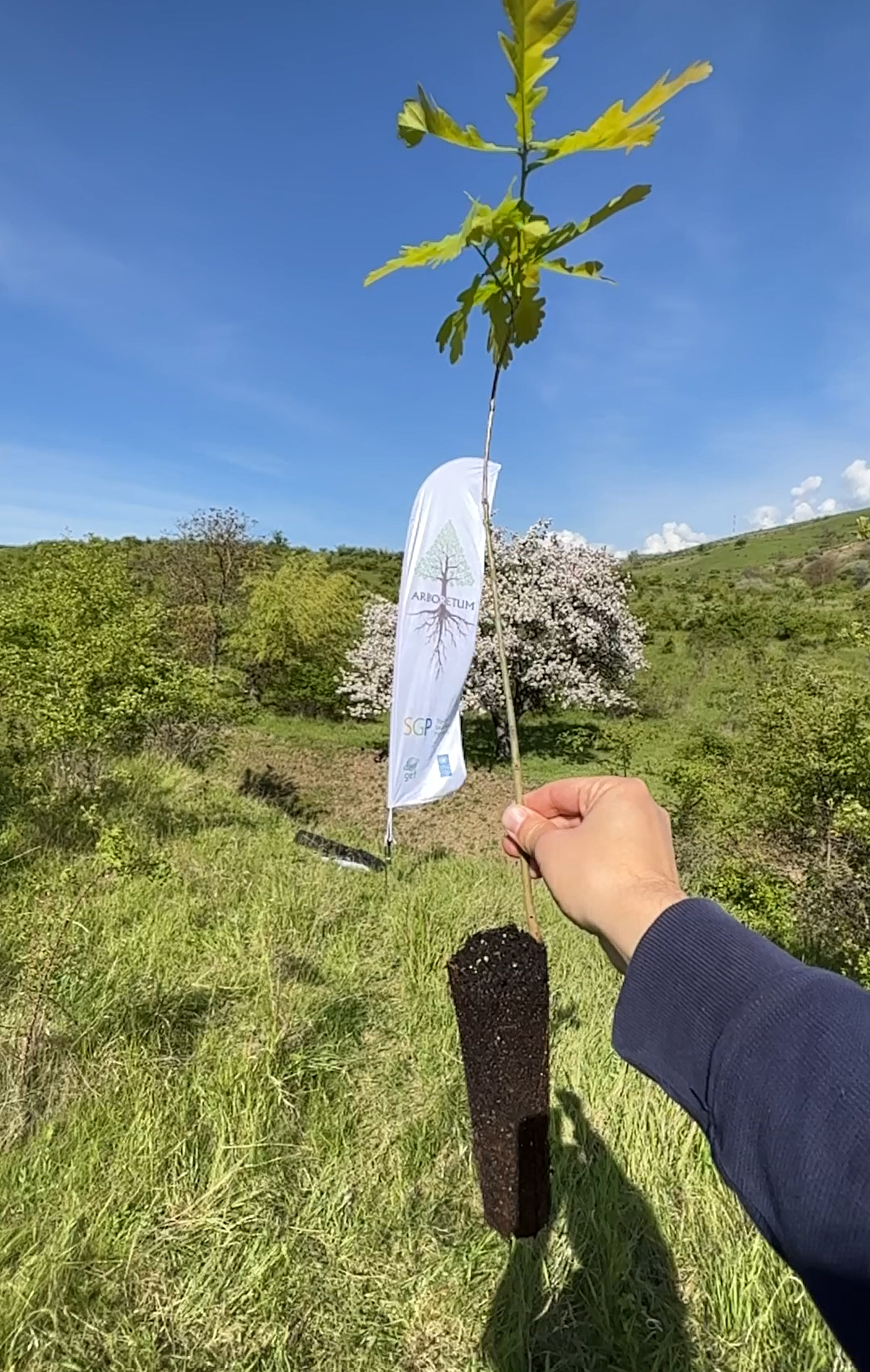
Those of you who have been following us for a long time know well how dedicated we have been in recent years to sustainable reforestation and, in particular, to the implementation of containerized culture for the native tree species of the Republic of Moldova. It has been and remains a long journey: curiosity, experiments, practical fieldwork, and sometimes quite a few "lessons learned" from attempts that did not go as expected.
But all the accumulated experience has convinced us of one simple fact: container technology is no longer a niche topic or a technical whim. In conditions where the climate is changing faster than institutions can adapt, this technology becomes a real lifesaver.
If you are hearing about this topic for the first time, we invite you to read our article where we briefly explain why containerized culture is capable of changing the Republic of Moldova's approach to reforestation. At the current pace of change, its advantages are more obvious than ever.
We also have good news: for the 2026 season, we are preparing to launch the first scientific demonstration project. We are very pleased to announce that we have signed an agreement with GIZ to launch the first demonstration project of applied scientific research on containerized culture in the Republic of Moldova.
We are implementing this project in collaboration with:
- Moldova State University,
- The Institute of Genetics, Physiology and Plant Protection,
- The Agency for Research and Development,
- The Forest Research and Management Institute
This is the first time this topic officially enters a structured research field, provided with infrastructure, protocols, indicators, and results that will be strictly documented.
More specifically, what is planned? As part of the pilot project supported by GIZ, we are equipping an experimental nursery with a production capacity of about 10,000 seedlings per year. This is a modest figure, but if we consider it from the perspective that this experimental batch is dedicated to just one species — Turkish Hazel (Corylus Colurna). We intend to study all possible combinations of containers, substrates, irrigation, fertilization, water stress, protection, hardening, and adaptation to transplanting.
This is, of course, just the beginning. Because in Moldova we have:
~ 20+ main forest species,
~ 90+ auxiliary species,
~ over 100+ species with potential for introduction in the context of climate change.
For each species, it is necessary to develop and scientifically justify a technological production map, as well as to ensure field trials. The truth is that without these data, the transition to mass production of containerized seedlings would be an extremely expensive lottery. We risk huge sums and precious time in it—which is often more valuable than money. Mistakes made can manifest themselves either in a year or two, or in 15–30 years.
Why do we need to speed up? Other countries began the transition to container technology 30–40 years ago. This seedling production system, developed in Scandinavian countries, is very well established for coniferous species, but not for broad-leaved ones...
According to confirmed data, the design and construction of 3 regional centers for the production of containerized forest planting material are planned and budgeted for the coming years, each with a capacity of 5 to 15 million seedlings per year... and to launch these centers today, there are no scientifically tested and verified technological production maps based on local genetic material. Moreover, no one in the Black Sea basin currently has such production maps for broad-leaved species!
The earlier we start the research, the closer we will be to a healthy implementation adapted to local realities. The longer we delay, the higher the risk of having modern nurseries but growing seedlings in them with mistakes. Very expensive mistakes...
And if we want Moldova to remain true to its own native species, the transition to container technology is, in fact, the only realistic path.
Why are we publishing this appeal right now? The project with GIZ allows us to take the first step on this path. But it covers only one species. If we want Moldova to move at the necessary speed and catch up with the climate change train, which has already gone far ahead, we need to accelerate.
To study more species in parallel, to create experimental nurseries in different regions, to document, compare, validate, and ultimately transfer technologies to state and private nurseries—a broader mobilization of research funds is required.
With this appeal, we invite any donor, organization, company, or institution that understands the importance of this line of work to consider this issue in their plans for 2026.
We are ready to bring to the table: technical projects, figures, justifications, previous results, collaboration models ensuring visibility and transparency, motivated researchers, and everything necessary to make an informed, reasoned, and fully transparent decision.
Every contribution matters. Including sharing this letter with those you think might be interested.
In conclusion — we sincerely thank you for the support and trust you have shown us all these years. There is a long road ahead!
In the coming months, we plan to publish materials on the progress of the project's first stages, and as we move forward, you will see how this initiative, which started a few years ago as an experiment out of pure curiosity, is increasingly clearly turning into a strategic project for the country's future. And it is quite possible that this development will be expanded precisely thanks to your participation.
With gratitude,
The LuRenOm / ARBORETUM Team
Related Posts
![More than 100 new trees were planted at the National Botanical Garden of Moldova [VIDEO]](https://arboretum.live/pub/media/mageplaza/blog/post/resize/400x/v/i/video-sreenshot_2.png)
More than 100 new trees were planted at the National Botanical Garden of Moldova [VIDEO]

HONEY CONVEYOR - BUILD YOUR OWN

Arde Planeta... Ce putem face?

Новая экологическая программа в Ниспорень. Партнерство с мэрией Вэрзэрешть.