Thrifty Trees: What a Tree Takes Back from Its Leaves Before They Fall

Source: Ksenia Pakhorukova, "Botanizirka" group (Facebook). Adapted from the author's post.
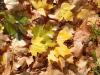
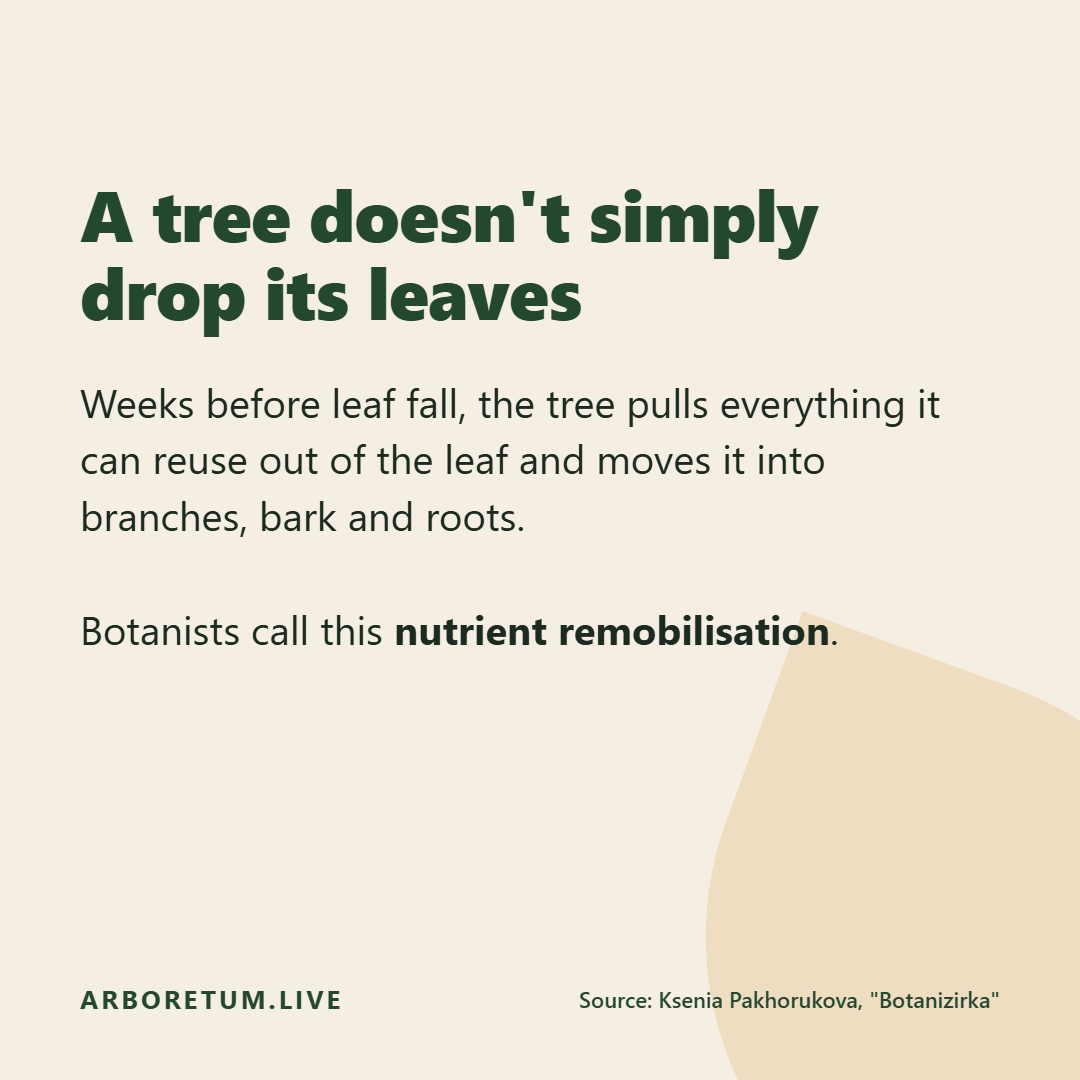
A leaf does not turn yellow and drop in a single day. Several weeks before leaf fall, the tree takes it apart piece by piece and moves everything of value into its branches, bark, trunk and roots. Botanists call this nutrient remobilisation, or resorption. Come spring, these reserves will feed the first leaves and shoots.
A leaf is an expensive thing
Over the season a leaf accumulates real wealth: proteins (enzymes among them), nucleic acids, membranes and mineral elements. Shedding all of it along with the leaf would be far too wasteful, so nature has arranged an orderly dismantling. The scientific name for leaf ageing is senescence, and it runs like this:
- complex molecules are broken down into simpler ones;
- the breakdown products are converted into mobile forms;
- they travel through the phloem, the conducting tissue of the bark, to storage organs;
- meanwhile, a special layer of cells forms at the base of the leaf stalk, along which the leaf will later separate from the twig.
The dismantling starts inside the cells. Proteins in the chloroplasts are cut up by enzymes called proteases. Part of the chloroplast contents is packed into tiny vesicles and sent to the vacuole, where the breakdown continues.
The resulting small molecules and ions still have to reach the phloem. Cell membranes carry channels and transporter proteins for this job. Many transporters can pump a substance even into places where it is already more concentrated, that is, against the concentration gradient.
The tree's transport highway
Phloem is a living conducting tissue. In trees it lies in the inner layer of the bark, the bast, just outside the cambium. Its backbone is the sieve tubes: chains of living cells divided by porous, sieve-like walls. A solution of sugars, amino acids and ions flows through them.
The concentrated solution draws in water, pressure builds up in the tubes, and the sap moves towards wherever the substances are unloaded. In summer, sugars leave the leaves in two directions at once: down to the roots and up to the growing shoot tips. In autumn, the flow from the leaves heads into the branches, trunk and roots. In spring it reverses: reserves move from the bark, wood and roots towards the opening buds.
Five elements the tree takes back
- nitrogen - the basis of proteins, including the enzymes of photosynthesis;
- phosphorus - part of ATP, DNA, RNA and cell membranes;
- potassium - the regulator of water balance and stomatal function;
- sulphur - a component of proteins and of glutathione, a small antioxidant molecule;
- magnesium - the central atom of chlorophyll and a helper to many enzymes.
Nitrogen
Most of a leaf's nitrogen sits in proteins, and a large share of them belongs to the photosynthetic machinery. The biggest nitrogen "warehouse" here is the enzyme RuBisCO (ribulose-1,5-bisphosphate carboxylase/oxygenase). It attaches carbon dioxide from the air to an organic molecule, starting the conversion of CO₂ into sugars. RuBisCO works slowly, so a leaf needs a great deal of it: in many species it accounts for up to half of the soluble leaf protein. Chlorophyll contains nitrogen too, but much less.
As the leaf ages, proteins are broken down into amino acids. Glutamine and asparagine are the most convenient for transport, each carrying two nitrogen atoms per molecule. These amino acids are called amides, and they travel through the phloem to the bark, shoots, buds and roots.
In poplars, willows and maples, special storage proteins form in the living cells of the inner bark for the winter. In spring they break down again, and the nitrogen goes into growth. Other deciduous trees also store nitrogen in bark and wood, not only in proteins but also as free amino acids. Apple trees, for example, hold a lot of arginine in their bark, an amino acid with four nitrogen atoms. Evergreens keep part of their nitrogen right in their mature leaves, and working proteins, RuBisCO included, double as their reserve.
Nitrogen often limits plant growth, which makes recovering it especially important. A well-studied example is the European aspen (Populus tremula). Swedish researchers followed a single tree in the north of the country and found that over the autumn it reclaimed about 80% of the nitrogen and phosphorus in its leaves. Under other conditions, of course, the figures may differ.
Phosphorus
Phosphorus is part of ATP, membrane phospholipids and nucleic acids. A sizeable share of it sits in RNA, mainly ribosomal RNA. To recover it, the cell deploys specialised enzymes: ribonucleases break down RNA, phospholipases break down membrane lipids, and phosphatases cut phosphate groups off organic compounds.
In the end, phosphorus ends up mostly as inorganic phosphate, the same ion the roots take up from the soil. Transporter proteins move it into the phloem. Phosphorus is often in short supply in the soil, so it pays for the tree to hold on to it.
Potassium
Potassium controls the water balance of cells, the work of the stomata, sugar transport and enzyme activity. It is not built into large molecules and exists in the cell as free K⁺ ions in the cytoplasm and vacuolar sap. That is why nothing needs to be dismantled to recover it: the ions pass through membranes via potassium channels and, with the help of transporters, move into the phloem. In fact, potassium is the main cation of phloem sap and helps maintain its pressure.
This mobility has a downside. Once the membranes of ageing cells are damaged, dissolved potassium is easily washed out by rain straight into the soil. So in measurements of potassium "resorption", part of the loss may simply be leaching.
Sulphur
Sulphur is found in two amino acids, cysteine and methionine. Cysteines from different parts of a protein chain link up through sulphur "bridges", and these cross-links hold many proteins in shape. Cysteine is also part of enzyme active sites and of iron-sulphur clusters, small groups of iron and sulphur atoms that shuttle electrons during photosynthesis. Every protein starts with methionine, which is also the source of regulatory compounds, including the plant hormone ethylene.
Sulphur is also part of glutathione, a small three-amino-acid molecule and one of the cell's main antioxidants.
After proteins break down, sulphur leaves the leaf in several forms: as sulphate, glutathione and sulphur-containing amino acids. In trees, its resorption has been studied less than that of nitrogen and phosphorus.
Magnesium
Magnesium sits at the centre of the chlorophyll molecule and takes part in the work of ribosomes and many enzymes. Its bond with ATP is especially important. In the cell, ATP mostly exists paired with a magnesium ion attached to its phosphate groups, a complex known as Mg-ATP. Magnesium partly neutralises the negative charges of the phosphates and gives the molecule the right shape, and only in this form can an enzyme conveniently "grab" ATP and split off a phosphate, releasing energy. That is why most ATP-using enzymes actually work with Mg-ATP.
Yet chlorophyll holds only a small fraction of the leaf's magnesium: from a few percent to a third, depending on the estimate. The rest is mostly dissolved in the cell as ions, with some bound to cell walls and insoluble salts in the vacuoles.
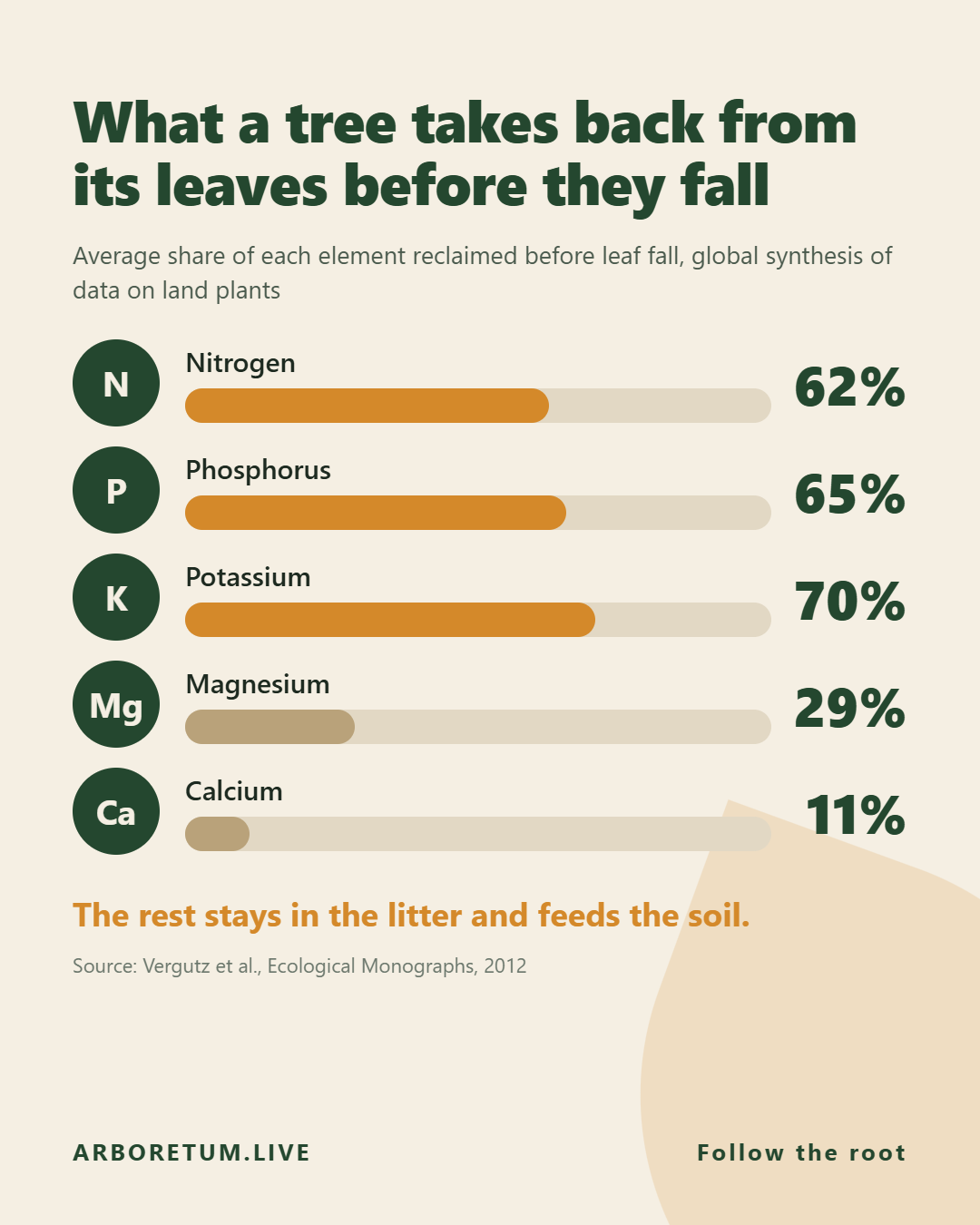
Magnesium is recovered noticeably less well than nitrogen, phosphorus and potassium. According to a global synthesis of data on land plants, leaves on average give back about 29% of their magnesium, compared with about 62% for nitrogen, 65% for phosphorus and 70% for potassium. These are averages across many species and regions, and individual trees can differ widely.
Sugars
Sugars are the product of photosynthesis. As long as a leaf can still work, it keeps sending sucrose to the trunk, branches and roots, where it can be turned into starch and other storage forms. As the leaf ages, photosynthesis gradually fades out.
Cellulose, lignin and their companions
Cellulose, hemicelluloses and lignin stay in the leaf. They form the framework of the cell walls, and the plant cannot break them into mobile fragments. They will become the basis of the leaf litter.
How mobile the elements are
Not all elements move through a plant equally well:
| Well recovered | nitrogen, phosphorus, potassium |
| Moderately | sulphur, magnesium |
| Usually poorly | calcium, iron, boron, in many species manganese |
Calcium is largely bound to cell walls and moves poorly through the phloem. Globally, leaves give back on average only about 11% of their calcium, and the rest falls with the leaf. How complete the resorption turns out to be depends on the species, soil fertility and moisture, the weather and the condition of the tree.
What about conifers?
Scots pine needles live for several years, but before dying they go through a similar process. In a study of the pine's assimilating apparatus, yellow dying needles contained noticeably less sulphur, magnesium and phosphorus than living ones. Some authors suggest that nitrogen and phosphorus also move from ageing needles into the shoots.
When the process is cut short
Remobilisation needs time and living cells. An early hard frost, drought or disease can interrupt it prematurely, and then the leaf falls carrying many elements the tree needs. You have probably seen trees drop still-green leaves after a sudden frost or a drought.
What stays in the fallen leaves
From here the soil part of the cycle begins. Rain washes out soluble compounds, soil animals shred the leaves, and fungi and bacteria decompose them. They have plenty to work with: even after efficient resorption, fallen leaves still hold a lot of useful material. This includes structural carbon, calcium and other low-mobility elements, some nitrogen, phosphorus and potassium, tannins and pigment breakdown products. Over time, all of it becomes available to roots again.
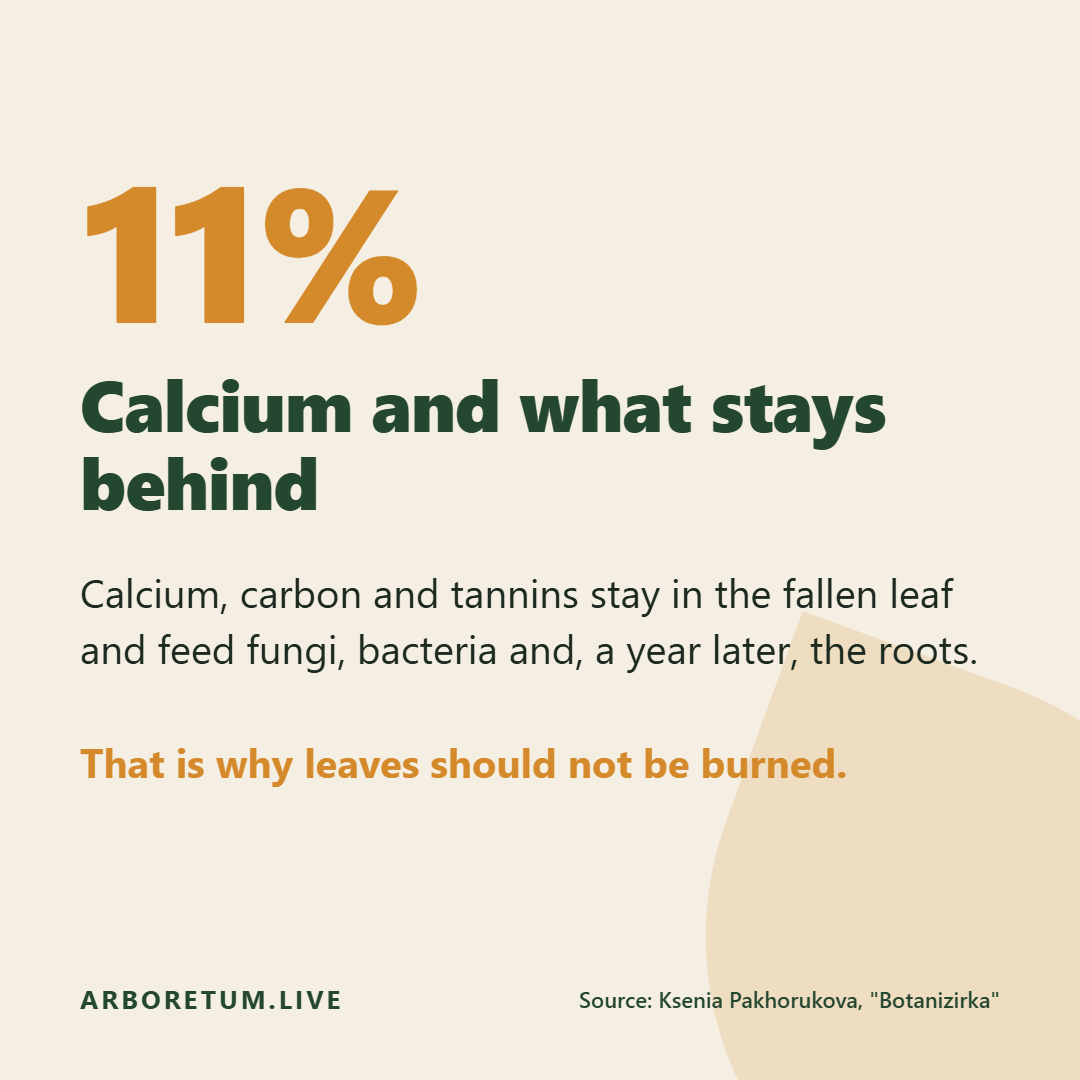
So every time we rake leaves into bags or burn them in the yard, we cut this cycle off halfway. The tree throws away nothing of value. We would do well to learn from it.
#MoldovaForests #Ecology
Related Posts
Planting Forests between Springs

Chyorna-Chernitsa - new working basin for Arboretum

Synthesis of Accumulated Ideas and Proposals


Soil Multidegradation and the Water Crisis in Moldova. Why Climate Is a Matter of National Security