Against GMO Liberalization: 26 Organizations and Experts Demand Withdrawal of Draft Law

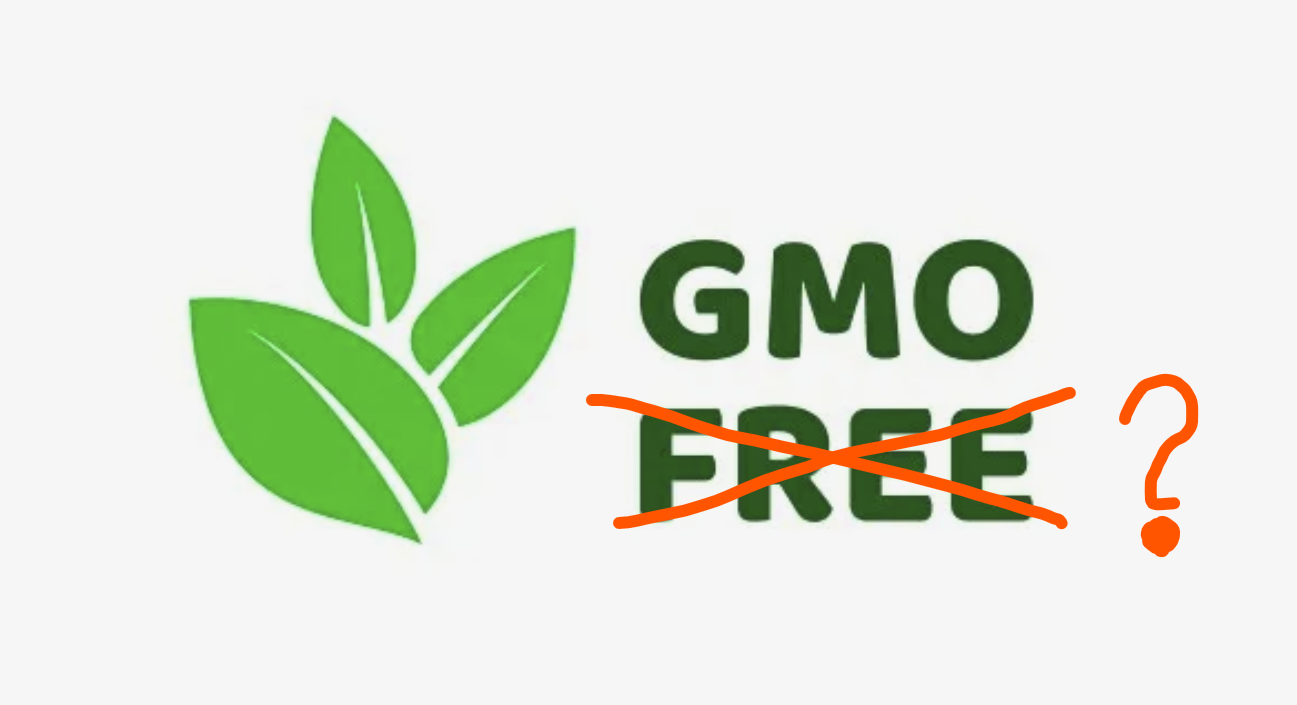
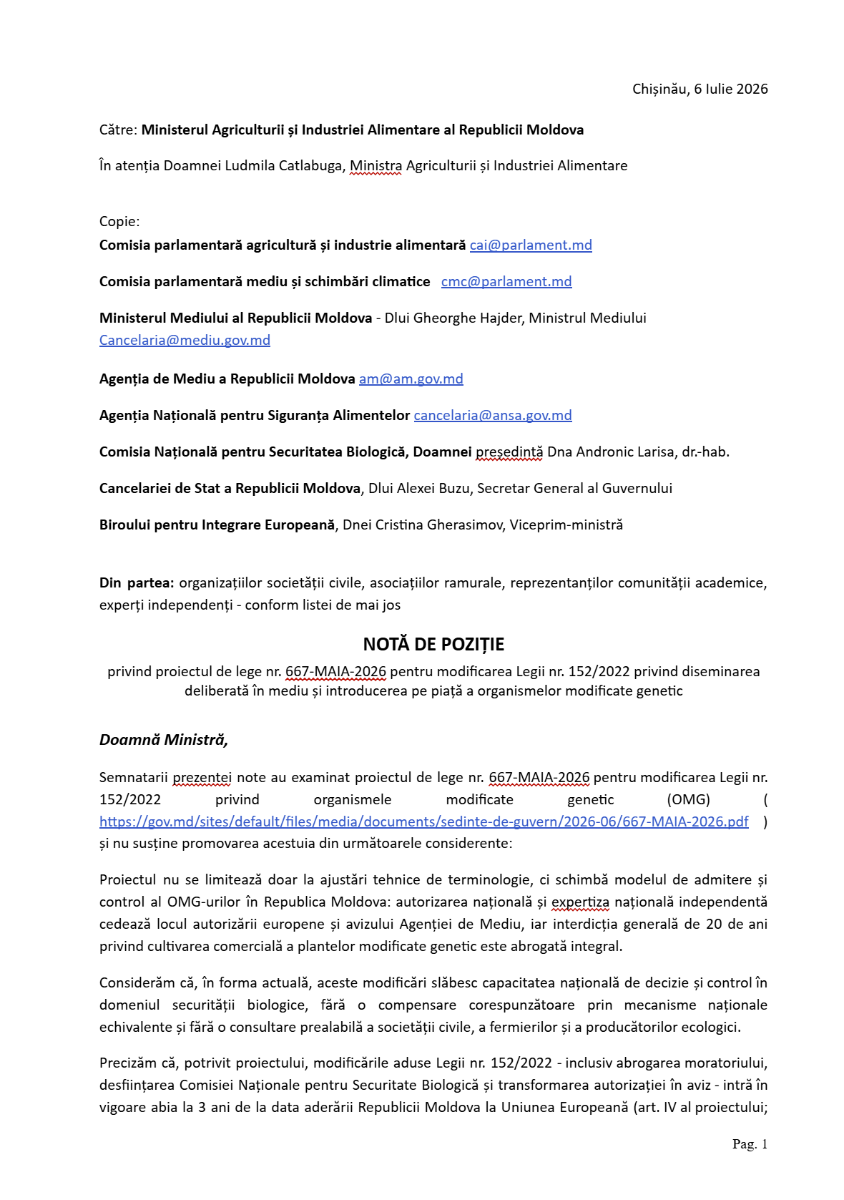
More than 25 civil society organizations, representatives of the academic community and independent experts have sent a joint appeal to the Ministry of Agriculture and Food Industry of the Republic of Moldova, demanding the withdrawal of draft law No. 667-MAIA-2026, which provides for radical changes to the legislation on genetically modified organisms (GMOs).
The initiative was registered on the particip.gov.md platform on June 11, the period for public comments closed on June 25, and on June 29 the document already received a positive endorsement at an interministerial meeting - all of this happened with virtually no real public discussion.
What exactly is being proposed to change in the legislation?
According to the petition's authors, the draft law "is not limited to technical adjustments, as officially declared, to align with European norms, but fundamentally reformats the model for regulating GMOs in the country." Instead of the national assessment and control system, Moldova is being asked to move to recognizing exclusively European authorizations. This could mean that the Environment Agency would receive only an advisory status, while the National Biosafety Commission is proposed to be abolished altogether.
The main content of the package:
- repeal of the 20-year moratorium that prohibits commercial cultivation of genetically modified plants;
- reduced cost of authorization procedures;
- the disappearance of national expertise;
- turning national authorization into a mere notification.
All of this is masked by the need for "harmonization with European legislation in the context of EU integration."
Why are such initiatives risky for Moldova?
The petition's signatories warn of concrete threats. First, Moldova risks losing an important competitive advantage - its status as a GMO-free country. This status secures premium prices for exporting organic and traditional produce to European and other demanding markets. Contamination of fields with genetically modified material would become irreversible.
Second, the draft does not provide for an adequate assessment of the consequences for small farmers and producers of organic products - precisely those who form the backbone of Moldova's agricultural sector.
Third, adopting this law in its current form undermines the country's sovereign right to independent expertise and control in the field of biosafety. At stake is the fate of the soil, biodiversity and food security on a national scale.
The global context: behind the scenes of trade wars
What is happening in Moldova is not accidental. It is part of a much larger global game. Amid intense trade negotiations between the US and the European Commission (de facto linked to the terms of American participation in NATO), the European Commission's position on GMOs has begun to thaw from a categorical "No" - though without saying "Yes" either!
The EU has shifted its focus toward national differentiation. The US and American GMO corporations are insistently demanding access to European markets, and the Commission has partly given ground - but on condition that each member state remains free to make its own decision.
In Europe itself, however, the opposite has happened: countries like France, Germany and Austria, rather than liberalizing their own sectors, have strengthened their own GMO control mechanisms, regardless of American pressure. None of them has weakened its protections.
The authorities of the Republic of Moldova, however, instead of following the example of European leaders, are choosing the opposite path - trying to become "more Catholic than the Pope." Critics see in this either a lack of awareness, or a willingness on the part of some members of the Moldovan elite to serve global corporate interests at the expense of national sovereignty.
The position of civil society
The document was signed by 26 organizations and experts, including think tanks, environmental NGOs, farmers' associations, academics, organic farming practitioners and scientists. Their joint call is clear: the draft must be fully withdrawn and the legislative process relaunched, with genuine, open public hearings involving farmers, organic producers, beekeepers, scientists and environmentalists...
As the statement emphasizes: "Moldova has a unique competitive advantage - traditional agriculture, rich biodiversity and the potential to develop organic production. Decisions in this area must be made on the basis of scientific data, risk assessment and open dialogue with society, not in haste and without discussion."
The petition has been submitted to the responsible ministries (Agriculture, Environment), agencies (environmental and food safety), and to the relevant parliamentary committees.
On hold - but not forgotten
At present, the draft law is on hold due to the government's resignation. But this by no means means the initiative has stalled. On the contrary, the temporary lull is a window of opportunity for society, media, partners and interested parties to speak up on the substance. Moldova faces a choice: remain a country in control of its own agricultural sector, or become a transit point for global corporate interests. This choice is too significant to be made without a conversation with society.
The petition remains open for signature by public and industry organizations, scientists and public figures.
We call on the media to cover this issue with the seriousness of a matter of national security.
https://docs.google.com/document/d/11Y5ELQInY_dYtWQgS2C7GYNnrWmuEobR29w0_2Ce2T4/edit?usp=sharing
Related Posts

HONEY CONVEYOR - BUILD YOUR OWN
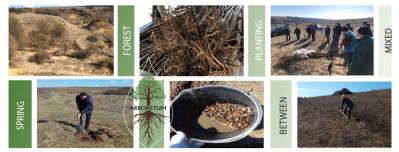
Planting Forests between Springs

A NEW MINISTER ORDER PROHIBITS FELLING IN THE FORESTS OF THE REPUBLIC OF MOLDOVA!