Forest Sector Reform: "Pădurile Moldovei" Must Not Become a Joint-Stock Company

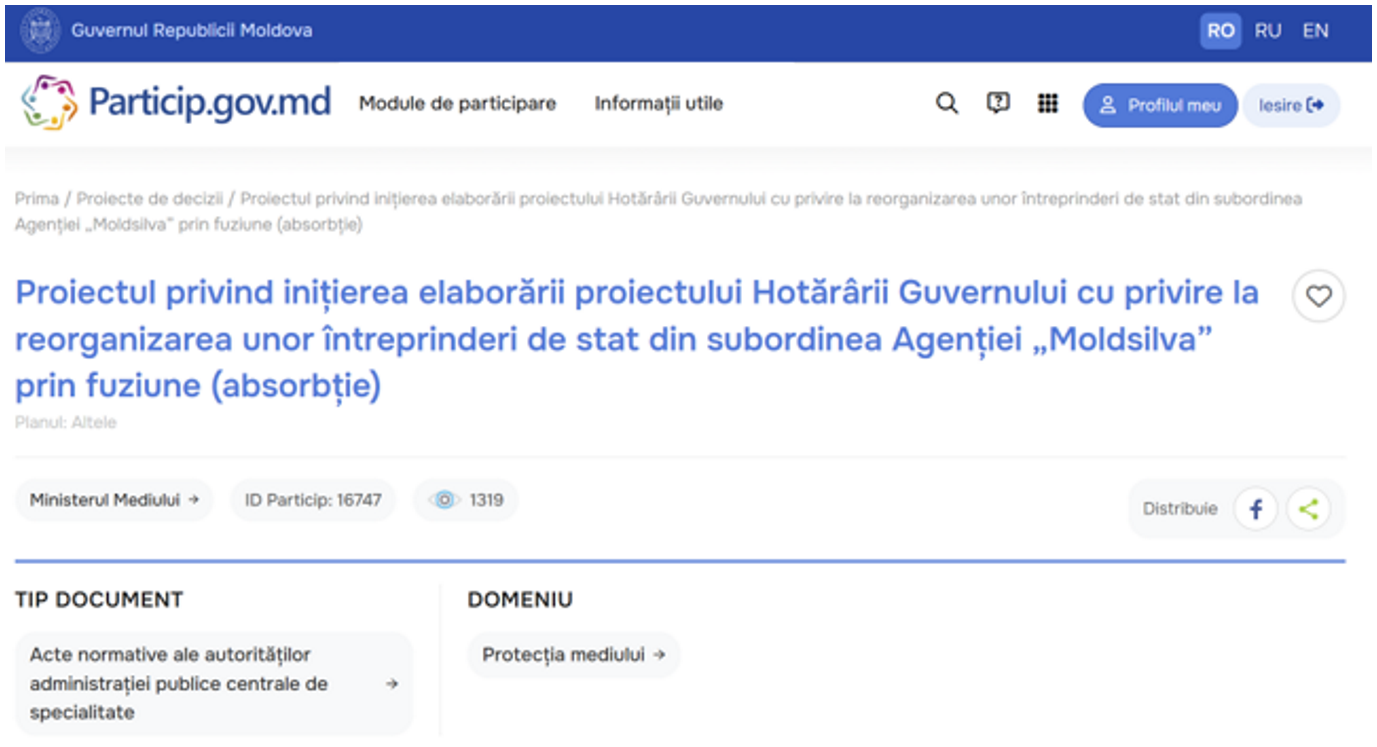
Tomorrow, 7 October, the public consultation closes on the draft Government Decision on the reorganization of state enterprises subordinated to the "Moldsilva" Agency. Today ARBORETUM submitted its proposals. In short: the 23 forestry and nature reserve enterprises under Moldsilva are to be merged into a single state enterprise, "Pădurile Moldovei" (Forests of Moldova), which after the merger would become a joint-stock company with 100% state capital. The shareholder would be the Ministry of Environment.
I have read the draft and its explanatory note several times and tried to set them against what our neighbours have done: Lithuania, Latvia, Estonia, Ukraine, Romania, Poland. My view is that the direction is right, but what is on the table for now is not a reform. It is a merger of assets, without the safeguards it needs.
The consultation deadline
The draft appeared on particip.gov.md on 24 September. The page has more than 1,300 views, only a few comments, and none of them approved. The sector talks a lot about the reform, but mostly in the corridors. Two weeks is far too little for a decision affecting some 338,000 hectares of state forest and more than 3,600 people working in the system. So our first request is to extend the deadline and hold a real public debate, with foresters at the table. It would also help to know who wrote the concept, so that people in the system can put their questions to them directly and take part in the discussion themselves.
Why not a joint-stock company
We support merging the enterprises. Today each of the 23 has its own accountants, lawyers and management, and money and machinery cannot be moved to where they are needed. Almost all our neighbours have ended up with a single national enterprise.
The joint-stock company is a different story. The explanatory note itself says that Law No. 246/2017 already gives a state enterprise a competitive selection of its director, performance indicators, audits and transparency. So what does the joint-stock form add? As far as I can see, only shares, which can be sold, pledged or diluted by a government decision. The forest land stays with the state, but the right to manage it, the machinery, the depots and the nurseries would go with the shares.
Poland, the Czech Republic and Lithuania do well with state enterprises. Latvia has a joint-stock company that works, but there the Forest Law explicitly prohibits privatizing its shares. Our draft says nothing about this.
The nature reserves
Codrii, Pădurea Domnească, Plaiul Fagului and Prutul de Jos (the last one is the core of Moldova's first UNESCO biosphere reserve) are also folded into the new enterprise, a structure judged by its financial result. The protected areas authority the note refers to does not exist yet. Ukraine took its nature reserves away from the forestry administration in 2020, and Slovakia began transferring national park lands in 2022. We are going the other way. I believe the reserves should go directly to a conservation agency, in one step, without an intermediate reorganization.
The Government decision and the law
The Forest Code assigns the management of state forests to the institution responsible for forestry. A joint-stock company owned by the Ministry does not fit this scheme, and a Government decision cannot override a code. So, alongside the decision, the Forest Code, the Contravention Code and the Criminal Code need to be amended.
There is also the question of timing. The current government won its confidence vote in July 2026, after its predecessor lasted less than a year. During our study visit to Lithuania I spoke with several people, including the expert who led the forest reform there. Their reform succeeded only on the third attempt; the first two fell along with the governments that started them. A law is much harder to change than a decision, and that is exactly what would protect the reform.
Who does the checking
Today planning, tree marking, harvesting, acceptance of works and timber sales are all in the same hands. The note acknowledges the problem but leaves the solution to a statute to be approved within 30 days. We are asking for logging to be controlled by someone outside the forest manager, for at least a third of the board to be independent members, and for a public advisory council with environmental NGOs.
Industrial timber and firewood
Industrial roundwood should be sold only through open electronic auctions, with the price published for each lot. Firewood is different: for many villages it is the only source of heat. We propose selling it from depots, already dried, at the lowest possible price and with an annual limit per household, so that speculators cannot buy it up. The gap up to cost should be covered by the state through a public service contract, not through extra logging.
Open data
In 2026 the Court of Accounts found that 337,700 hectares of forest land are not recorded in the accounts and only 55,300 are registered in the cadastre. Under these conditions I doubt the inventory can be done in 12 months. We are asking for a realistic timetable and a new information system launched together with the merger. And logging plans, felling allotment records and timber transports should be visible online to anyone, without having to file a request.
Protected areas and black locust
Black locust covers about a third of our forests, and many protected areas have stands that have nothing to do with the natural habitat. Yet the Forest Code bans final fellings in these areas, even when the aim is precisely to restore the natural forest. Our proposal is simple: the unsuitable stand is harvested, only species of the natural habitat are planted in its place, and once the forest has formed, it is left alone to regulate itself.
Instead of a conclusion
Once again the draft puts economic interest and productivity first. But in a country with 11.6% forest cover, forests play above all an ecosystem role: they hold the soil, the water and everything that lives around them. If the reform starts from the balance sheet rather than from the forest, we risk ending up with a better balance sheet and a poorer forest.
We have sent the full document, with 17 questions and 32 proposals, to the Ministry of Environment. Until tomorrow, 7 October, anyone can still comment on particip.gov.md.
And anyone who wants to add to our proposals or share new ideas can leave them directly in our working document. We will take them into account in the next stages of the discussion.
The working document is open for comments
You can scroll through it below. To leave a comment or a proposal, open the document from the heading above.
#MoldovaForests #Moldsilva #ForestReform
Related Posts
Planting Forests between Springs
A NEW MINISTER ORDER PROHIBITS FELLING IN THE FORESTS OF THE REPUBLIC OF MOLDOVA!
![Prima prezentare ARBORETUM în Sudul Moldovei [VIDEO]](https://arboretum.live/pub/media/mageplaza/blog/post/resize/400x/t/a/taraclia_ro.jpg)
Prima prezentare ARBORETUM în Sudul Moldovei [VIDEO]
Our first presentation at Taraclia