European Commission proposes requiring EU countries to plan for 3°C of warming

On 27 October the European Commission presented a draft European Climate Resilience Law. Brussels proposes that the governments of all EU countries plan their policies and investments for a world that is around 3°C warmer than pre-industrial levels by 2100. The Financial Times, which reported on the preparations, cited 2.8°C. The Commission's own documents say "around 3°C", while 2.8°C is the UN Environment Programme's estimate for current global climate policies. The gap is small but it matters: this is not a forecast but a planning baseline from which decisions are meant to start.
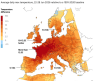
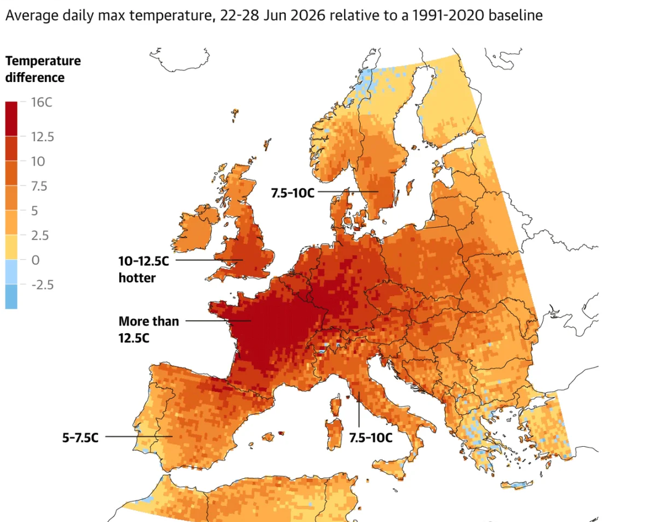
The Commission's case is straightforward. Europe is warming roughly twice as fast as the global average, and the summer of 2026 showed what that gap costs. According to a modelled estimate by researchers at Imperial College London and the London School of Hygiene and Tropical Medicine, heat killed more than 50,000 people in 854 cities across 30 European countries, and about 65% of those deaths are linked to climate change. It is not an official statistic, but the scale speaks for itself. Climate Commissioner Wopke Hoekstra put the economic damage of this summer's extreme weather at more than EUR 100 billion and admitted that even if we do everything right on cutting emissions today, it will not be enough to protect citizens from danger. The 1.5°C goal stays.
Under the draft, each country would adopt a single national strategic plan on climate resilience by 31 December 2030, replacing four existing planning instruments. National climate risk assessments are proposed by 30 June 2029 and every five years after that. Governments would have to designate a coordinating authority and name who is responsible for each major risk, whether heat, drought, wildfires or floods, and local and regional authorities are meant to be involved in drawing up the plans. The plans would have to promote nature-based solutions, and the Commission wants to review countries' progress every two years through the European Semester. It intends to deliver an EU-wide strategic plan in the third quarter of 2028.
Money is the weak spot. Adaptation is expected to need around EUR 70 billion a year until 2050, and the draft does not yet name where the money will come from: the law itself brings no new funding. There are only existing instruments, none of them dedicated to adaptation alone. Adaptation spending is meant to count towards the target of at least 35% of the 2028-2034 EU budget going to climate and environment; the European Investment Bank plans at least EUR 30 billion for adaptation in 2026-2030, and the Social Climate Fund will provide up to EUR 86.7 billion to support vulnerable groups, including resilience measures. Among the next steps the Commission lists a European heatwave plan, a climate insurance alliance (only about a quarter of disaster losses are insured today), a European water initiative and a list of the 100 most climate-vulnerable territories.
Criticism comes from both sides. Peter Liese of the European People's Party backs clearer responsibilities but warns that plans alone do not protect people and could tie up resources unnecessarily unless they are designed pragmatically. Kai Tegethoff of the Greens fears a document that tells us exactly how exposed we are and then commits us to nothing. The draft still has to go through the European Parliament and the Council, so the final text may change.
Moldova is a candidate country for EU membership, and the law does not apply to it directly until it becomes a member. But it is logical to expect that such planning requirements will sooner or later reach us too, and heat, drought and water shortages are not an abstract scenario for Moldova. For those who work with forests, the draft contains a detail worth noting: nature-based solutions, meaning reforestation, urban greening and the restoration of river channels and catchments, are named among the things countries should support. A law can be written in a year. A forest that cools a city and holds water in the soil takes decades to grow. The clock starts at planting, not at the adoption of a plan.
Primary sources: European Commission, "Protecting Europe with stronger climate-resilience", draft regulation COM(2026) 730, Commission Communication COM(2026) 720.
Related Posts
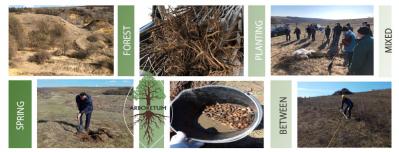
Planting Forests between Springs
A NEW MINISTER ORDER PROHIBITS FELLING IN THE FORESTS OF THE REPUBLIC OF MOLDOVA!
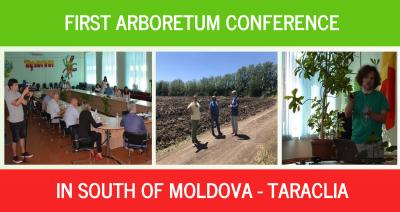
Our first presentation at Taraclia

EU Green Deal capătă Contur